
Claude vs Wikipedia: Which Is Better For Research, Accuracy, Sources, and Citations?
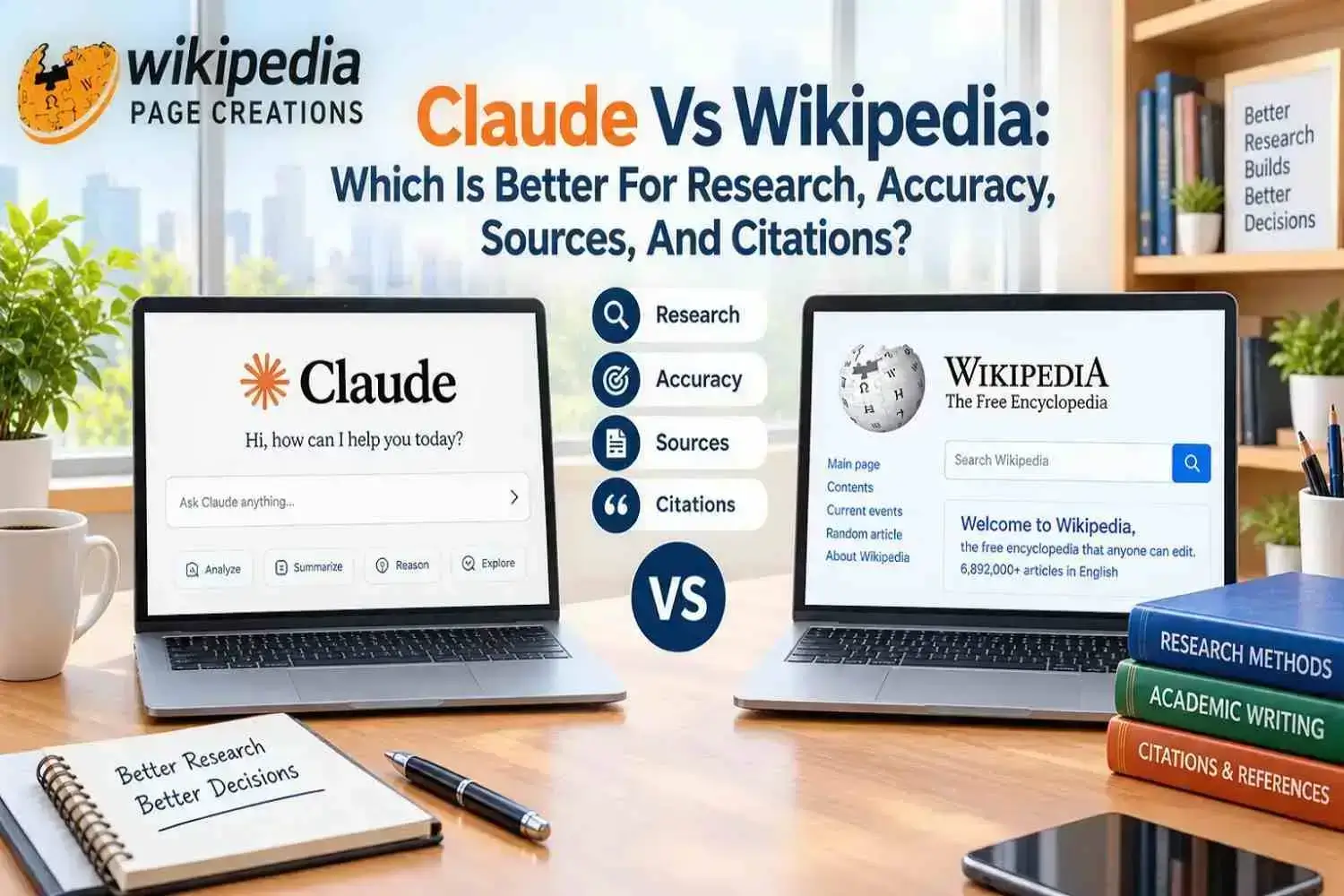
The way to research has now changed. You can spend an hour with open tabs or ask an AI assistant to turn a messy question into a readable explanation within seconds. This convenience makes Claude vs Wikipedia an interesting comparison, but they solve different parts of the research problem.
Wikipedia is just a collaboratively edited encyclopedia that is built around published sources, and Claude is a language model that is designed to analyze, summarize, and reason over information, and when the appropriate tools are enabled, you can search external material. When it comes to understanding that difference, it is more than simply asking which one is better.
Claude Vs Wikipedia: How Do They Actually Differ?
The biggest difference is simple that one is a reference work that is maintained by people, and the other can generate responses from a trained model and whatever information or tools are available in the conversation.
● Research Speed And Convenience
It can be remarkably useful to start research with Claude. You should give it a complicated question, a PDF, notes, or several passages. It can identify themes, compare arguments, explain terminology, and turn scattered material into a workable research direction.
Wikipedia is a different route for the research process. You browse an article, inspect references, follow linked pages, and decide which sources deserve closer attention. That can take longer, but the process can expose you to the underlying evidence. The best Wikipedia page creation service or the best Wikipedia strategies can also help you navigate the platform’s editorial and sourcing requirements for organizations that need professional support with Wikipedia-related projects.
● Accuracy Depends On Verification
You should not treat a resource as automatically correct. The current documentation of Anthropic explicitly acknowledges that Claude can produce incorrect facts, fabricated details, and citation errors. The latest model of this documentation also distinguishes between what a model knows and what it can establish through external tools.
Wikipedia has its own limitations, but its editorial system can emphasize verifiability, neutrality, and published reliable sources. Its articles can also retain histories and discussion pages that let readers see how information has developed. You need to understand the Wikipedia guidelines to help readers evaluate whether important claims are properly supported and presented.
● Which Has Better Sources?
Wikipedia can be surprisingly valuable for source discovery. References at the bottom of an article often lead directly to books, government material, academic papers, journalism, or other primary and secondary sources.
Claude can help you understand those sources faster than Wikipedia. It can help you summarize a long paper, compare two arguments, or explain unfamiliar terminology. The catch is that citations in an AI response still need checking against the original material. Reliable Wikipedia page creators may help organizations maintain an existing Wikipedia presence while still working within Wikipedia’s sourcing and editorial expectations.
The Wikipedia editor community also plays an important role in maintaining articles, discussing changes, and identifying sourcing problems. This collaborative process can give readers an additional editorial trail that can differ from an AI-generated response.
● Citations Are Not the Same Thing
A Wikipedia citation can generally point to an identifiable published source that is attached to a specific claim. This can make verification relatively straightforward.
Claude’s citation capabilities depend on the version and tools being used. Anthropic documents have web search and fetch capabilities for current Claude systems and also warn that models can fabricate citations or confuse dates. That difference matters, especially for academic, medical, legal, or professional research.
● What About Claude Vs ChatGPT?
This practical question is not just about Claude, but this is also about how different AI assistants handle research workflows. Models can summarize, organize, reason, and draft, but their outputs remain generated responses rather than automatically authoritative references.
For example, someone researching Claude vs. Wikipedia coding may use Claude to understand an implementation or compare programming approaches and consult Wikipedia to establish historical or conceptual context. It helps to treat AI as a research assistant and sources as evidence.
● What Does Claude Wikipedia Mean In Practice?
When you search for “Claude Wikipedia,” it may lead you to an encyclopedia entry, an AI-generated explanation, or discussions about how AI systems can interact with Wikipedia.
Human editing itself is maintaining Wikipedia. Wikimedia reported nearly 250,000 volunteer editors globally in 2025, with 94 million changes made across language editions that year. A trusted Wikipedia page monitoring service can provide ongoing oversight of changes, references, and article developments for organizations concerned with keeping Wikipedia information current over time.
How Should You Use Both For Better Research?
A strong workflow doesn’t require choosing one permanently. Use each resource where its strengths matter most.
- Start with Claude: You can use it to clarify the question, generate research angles, define unfamiliar terms, or organize a complicated topic.
- Open Wikipedia: Now you need to open Wikipedia to establish basic context and identify the major concepts, dates, people, and related subjects.
- Follow the references: Follow references instead of stopping at the encyclopedia summary. This is where the best Wikipedia strategies become useful.
- Check Original Sources: You can now check sources for important claims, quotations, statistics, and disputed information.
- Return to Claude: Now you need to go back to Claude with verified material and ask it to compare, structure, summarize, or explain the evidence.
- Apply Wikipedia guidelines: You should now apply Wikipedia rules when evaluating an article by inspecting its citations, talk-page discussions, revision history, and whether important claims are properly sourced.
When human review is required, you can consider expert Wikipedia editors to help assess article structure, sourcing, and compliance with relevant editorial standards.
Claude Vs Wikipedia: Which One Should Researchers Use?
No single tool is the universal winner because each serves a different purpose. Claude can save substantial time for quick explanations, brainstorming, synthesis, document analysis, and research organization. Wikipedia has a different advantage for tracing claims to published references, understanding an article’s editorial development, and exploring a network of established sources.
The scale of Wikipedia is so substantial that the Wikimedia Foundation reported more than 65 million articles across 300+ languages and roughly 15 billion monthly views in 2026. The practical answer to Claude vs Wikipedia is not about picking one. You can use Claude to think through information, Wikipedia to orient yourself, and primary or authoritative sources to establish what you can confidently cite. This approach can work better than relying on ChatGPT vs Wikipedia as a simple either-or comparison.
Frequently Asked Questions
1. Is it accurate enough to use Wikipedia for research?
Wikipedia is useful for background research and finding references, but you should check important claims against the sources that are cited in the article. You should treat the encyclopedia as a starting point, not the final authority for academic or professional work.
2. Why is Wikipedia still useful with AI everywhere?
Wikipedia is offering something like generated answers, but it does not automatically provide a visible editorial trail. Readers can inspect those references, revisions, and discussions to see how an article evolved. Its large volunteer community continuously updates and reviews content across hundreds of language editions.
3. Which is the safest research method for students?
You can use AI for exploration and synthesis, Wikipedia for orientation and source discovery, and other sources for verification. You should check the publication date, supporting evidence, author or institution, and whether independent reputable sources reach similar conclusions for significant claims. The Wikipedia editor community and article history can also provide you with useful context when you are assessing how information has been developed.
The Bottom Line
Claude vs Wikipedia is really a comparison between an interactive research assistant and a collaboratively maintained reference encyclopedia. Claude is useful for synthesis, organization, explanation, and working through large amounts of material. Wikipedia is valuable for context, linked references, and transparent editorial history. Neither removes the need for verification. The strongest research workflow can combine both with sources.

I am a digital reputation specialist and expert in encyclopedic content standards. With my blogs I try to bridge the gap between brand storytelling and Wikipedia’s rigorous notability requirements. By focusing on verifiable sourcing and neutral point-of-view writing, I help high-profile individuals and global organizations establish a credible, permanent digital footprint that stands the test of scrutiny.”